
Improving operational efficiency requires organizations to look closely at how work is planned, performed, measured, and improved. It is not simply about reducing costs or asking employees to work faster. Sustainable operational efficiency improvement comes from removing unnecessary activities, improving processes, strengthening workforce productivity, and creating systems that support consistent performance. For organizations across Saudi Arabia, these principles can support broader Operational Excellence and business transformation objectives. A structured approach helps organizations understand where operational losses occur, prioritize improvement opportunities, and build continuous improvement into everyday management.
Key Takeaways
- Improving operational efficiency starts with understanding how work actually flows through an organization.
- Process improvement and Lean management can help identify waste, delays, variation, and unnecessary activities.
- Workforce productivity depends on effective processes, clear responsibilities, appropriate skills, and supportive management systems.
- Digital transformation can improve operational efficiency when technology is aligned with clearly defined business needs.
- Continuous improvement helps organizations sustain operational gains rather than treating efficiency as a one-time initiative.
What Is Operational Efficiency?
Operational efficiency refers to how effectively an organization uses its available resources to deliver its intended results.
These resources can include:
- People
- Time
- Equipment
- Materials
- Information
- Financial resources
- Technology
An operationally efficient organization aims to achieve desired outcomes while minimizing unnecessary effort, waste, delays, errors, and resource consumption.
This is different from simply increasing activity.
For example, completing more work does not necessarily mean an organization has become more efficient if the additional output requires excessive rework, overtime, duplicated activities, or inefficient processes.
The objective of improving operational efficiency initiatives should therefore be to improve the system in which work is performed.
Why Operational Efficiency Matters in Saudi Arabia
Organizations across Saudi Arabia are strengthening their focus on Operational Excellence, productivity, business transformation, and sustainable performance.
Saudi Vision 2030 places significant emphasis on developing a diversified and thriving economy, improving efficiency, and strengthening the capabilities required for long-term economic development.
For individual organizations, operational efficiency provides a practical connection between strategic objectives and day-to-day execution.
Improved operational efficiency can help organizations:
- Make better use of resources
- Reduce unnecessary process steps
- Improve responsiveness
- Strengthen consistency
- Improve workforce productivity
- Reduce avoidable errors
- Improve visibility into performance
- Support continuous improvement
The challenge is determining where improvement efforts should begin.
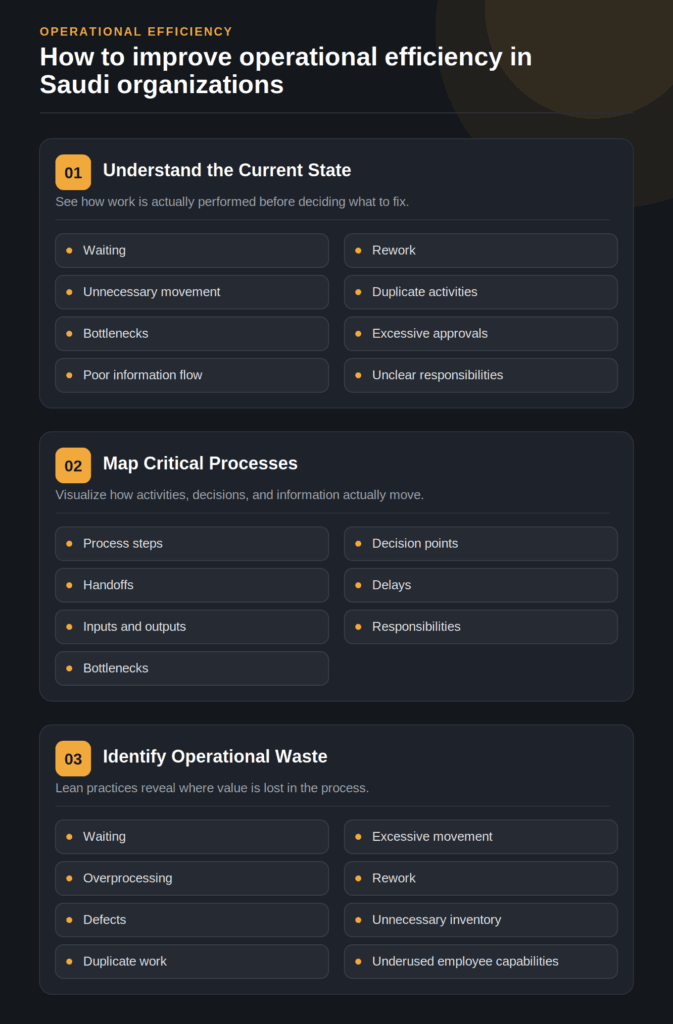
How to Improve Operational Efficiency in Saudi Organizations
1. Understand the Current State
The first step is to understand how work is actually performed.
Organizations often make improvement decisions based on procedures, assumptions, or high-level reports without examining the actual process. Process observation can reveal:
- Waiting
- Rework
- Unnecessary movement
- Duplicate activities
- Bottlenecks
- Excessive approvals
- Poor information flow
- Unclear responsibilities
Understanding the current state creates a factual foundation for operational efficiency improvement.
Organizations should look at the complete process rather than focusing only on individual departments.
2. Map Critical Processes
Process mapping provides visibility into how activities, decisions, information, and resources move through an organization.
A process map can help identify:
- Process steps
- Decision points
- Handoffs
- Delays
- Inputs and outputs
- Responsibilities
- Bottlenecks
This makes it easier to distinguish necessary activities from those that could be simplified, removed, or redesigned.
3. Identify Operational Waste
Lean management provides practical methods for identifying waste within processes.
Waste can take many forms, including:
- Waiting
- Excessive movement
- Overprocessing
- Rework
- Defects
- Unnecessary inventory
- Duplicate work
- Underused employee capabilities
The purpose is not simply to eliminate activities.
Organizations need to understand why an activity exists and whether it contributes meaningful value.
This makes Lean management an important component of broader Operational Excellence strategies in Saudi Arabia.
Improve Operational Efficiency Through Process Improvement
Standardize Important Activities
When employees perform the same process in significantly different ways, performance can become inconsistent.
Standardized work establishes a clear baseline for important activities.
It can help organizations:
- Improve consistency
- Clarify responsibilities
- Support employee training
- Reduce unnecessary variation
- Make performance easier to evaluate
- Create a foundation for future improvement
Standardization should not prevent improvement. Instead, it provides a stable reference point from which better methods can be identified.
Reduce Process Variation
Variation can make performance unpredictable.
Organizations should investigate why similar processes produce different results and determine whether differences are necessary or caused by inconsistent methods.
Reducing unnecessary variation can improve process stability while making performance easier to manage.
Improve Handoffs
Processes frequently cross organizational boundaries.
Every handoff between teams creates a potential opportunity for delay, information loss, duplication, or misunderstanding.
Organizations can improve efficiency by clarifying:
- Who owns each activity
- What information must be transferred
- When the handoff occurs
- What constitutes a complete handoff
- How exceptions are handled
Improving handoffs can strengthen overall process flow.
Improve Workforce Productivity
Workforce productivity is closely connected to process design.
Employees cannot consistently perform at their best when they are working within inefficient systems.
Organizations should examine whether employees spend unnecessary time on:
- Repetitive administrative activities
- Searching for information
- Correcting errors
- Waiting for approvals
- Resolving unclear responsibilities
- Repeating work
- Managing avoidable process problems
Improving these conditions can increase productivity without simply increasing workload.
Employee involvement is also important. People who perform processes regularly often have direct knowledge of operational problems and practical improvement opportunities.
Strengthen Performance Management
Operational efficiency requires visibility. Organizations need relevant measures that show whether processes are performing as expected and where attention is required.
Depending on organizational objectives, performance measures may relate to:
- Productivity
- Quality
- Lead time
- Cost
- Delivery
- Resource utilization
- Process adherence
- Customer responsiveness
The objective should not be to create large numbers of metrics. Instead, organizations should identify measures that help teams understand performance and make better decisions.
A useful performance management system connects organizational objectives with operational activity.
Use Root Cause Problem Solving
Repeatedly correcting the same problem is a sign that an organization may be addressing symptoms rather than causes.
Root cause analysis helps teams investigate why a problem occurs and determine what needs to change to prevent recurrence.
A structured problem solving approach can include:
- Define the problem.
- Understand the current condition.
- Collect relevant information.
- Identify potential causes.
- Validate the root cause.
- Develop corrective actions.
- Monitor the results.
- Standardize successful improvements.
This strengthens organizational effectiveness by improving the organization’s ability to solve problems systematically.
Improve Operational Efficiency Using Lean Management in KSA
Lean management initiatives can provide a structured framework for improving operational efficiency in KSA.
Common Lean methods include:
Value Stream Mapping (VSM)
Helps visualize the complete flow of information and activities while identifying delays, waste, and improvement opportunities.
5S
Supports workplace organization, visibility, discipline, and standardization.
Kaizen
Encourages employees to identify and implement incremental improvements.
Standardized Work
Creates consistent methods for performing important activities.
Visual Management
Makes important operational information easier to understand and act upon.
The appropriate Lean method depends on the problem being addressed. Organizations should avoid implementing tools simply because they are associated with Lean. The starting point should always be the business problem.
Improve Operational Efficiency Through Digital Transformation
Digital transformation can contribute to operational efficiency when technology is applied to clearly understood business needs. Potential applications include:
- Automating repetitive activities
- Improving information availability
- Reducing manual reporting
- Strengthening performance visibility
- Supporting workflow management
- Improving data analysis
- Supporting decision making
However, technology should not automatically be considered the solution to an inefficient process.
If an organization automates a process that contains unnecessary approvals, duplicate work, or unclear responsibilities, it may simply automate the inefficiency.
A stronger sequence is:
Understand → Simplify → Standardize → Automate → Improve
This provides a practical foundation for organizations looking to improve operational efficiency through digital transformation in Saudi Arabia.
Build Continuous Improvement Into Daily Management
Operational efficiency should not be treated as a one-time project. Processes change. Business priorities change. Customer expectations change. New problems emerge. For this reason, organizations need mechanisms that allow improvement to continue after an initial initiative has been completed.
A continuous improvement system can include:
- Regular performance reviews
- Problem identification
- Root cause analysis
- Improvement actions
- Employee feedback
- Follow up reviews
- Standardization of successful changes
This creates an ongoing improvement cycle.
Improve Organizational Effectiveness Through Better Alignment
Operational efficiency is not only a process issue. Organizational effectiveness depends on alignment between:
- Strategy
- Leadership
- People
- Processes
- Performance measures
- Technology
If these elements operate independently, improvement initiatives can become fragmented.
For example, a new process may be introduced without updating performance measures. Employees may then continue to be evaluated according to the old expectations.
Effective organizations align these elements so that strategy and daily execution reinforce one another.
A Practical Roadmap to Improve Operational Efficiency
Organizations can approach operational efficiency improvement through a structured sequence.
Step 1: Define the Objective
Determine what needs to improve and why.
The objective could involve productivity, quality, cost, responsiveness, process stability, or resource utilization.
Step 2: Assess the Current State
Observe processes and collect relevant information.
Step 3: Identify Improvement Opportunities
Prioritize waste, bottlenecks, variation, delays, and other operational losses.
Step 4: Design Improvements
Use process improvement, Lean management, standardization, workforce improvement, or technology according to the specific need.
Step 5: Implement Changes
Assign responsibilities, communicate expectations, and provide appropriate support.
Step 6: Measure Performance
Monitor relevant indicators to determine whether the change is producing the intended result.
Step 7: Sustain the Improvement
Standardize successful practices and establish regular review mechanisms.
Step 8: Continue Improving
Use the results as a starting point for the next improvement cycle.
Common Mistakes When Improving Operational Efficiency
Focusing Only on Cost Reduction
Cost is an important consideration, but operational efficiency should also consider quality, productivity, responsiveness, employee capability, and customer value.
Improving Individual Departments in Isolation
A department may optimize its own performance while creating problems for another part of the process. Organizations should evaluate end-to-end process performance.
Automating Poor Processes
Technology should support process improvement rather than replace it.
Ignoring Employees
Employees should be involved in identifying problems and developing practical solutions.
Measuring Too Many Things
Excessive metrics can make performance management more complicated without improving decision making.
Treating Improvement as a One-Time Initiative
Sustainable efficiency requires continuous review and improvement.
Conclusion
Organizations seeking to improve operational efficiency in Saudi Arabia need a structured approach that connects processes, people, performance, and technology.
The most effective starting point is understanding the current state of work and identifying where waste, delays, variation, and unnecessary effort occur. From there, organizations can apply Lean management, process improvement, workforce productivity practices, performance management, and digital transformation where appropriate.
Operational efficiency is ultimately about creating better systems for achieving organizational objectives. When improvement becomes part of everyday management and continuous improvement becomes an organizational capability, businesses can strengthen Operational Excellence while building more consistent and sustainable performance.
Frequently Asked Questions
How can organizations improve operational efficiency in Saudi Arabia?
Organizations can improve operational efficiency by understanding current processes, identifying waste and bottlenecks, standardizing important activities, improving workforce productivity, strengthening performance management, and applying Lean and digital improvement methods where appropriate.
What is operational efficiency improvement?
Operational efficiency improvement is the structured effort to achieve better organizational results while reducing unnecessary resource consumption, delays, waste, variation, and process complexity.
How can Lean management improve operational efficiency in KSA?
Lean management can improve operational efficiency by identifying waste, improving process flow, standardizing work, addressing root causes, and involving employees in continuous improvement.
How can digital transformation improve operational efficiency?
Digital transformation can improve operational efficiency by automating suitable activities, improving information flow, strengthening performance visibility, supporting data analysis, and enabling better decision making. Technology should be applied after the underlying process has been properly understood.
What is the role of continuous improvement in operational efficiency?
Continuous improvement helps organizations sustain operational gains by regularly identifying performance gaps, solving problems, implementing improvements, and standardizing successful practices.