
Artificial intelligence and automation are changing how organizations approach efficiency, productivity, and business process improvement. However, technology alone does not guarantee better performance. Organizations need to understand their processes, identify sources of inefficiency, and determine where automation or AI can create meaningful value. For businesses across Saudi Arabia, this approach can connect technology adoption with broader Operational Excellence and digital transformation objectives. The goal is not to automate everything, but to use appropriate technologies to reduce repetitive work, improve information flow, support decision making, and enable people to focus on higher value activities.
Key Takeaways
- AI and automation can improve productivity when applied to clearly defined business problems.
- Organizations should understand and improve processes before automating them.
- Automation can reduce repetitive activities and improve consistency across suitable processes.
- AI can support analysis, forecasting, decision making, and information management when appropriate data is available.
- Sustainable technology adoption requires people, processes, governance, and technology to work together.
Why AI and Automation Matter for Productivity
Organizations looking to improve efficiency and productivity often begin by examining where time and resources are being consumed.
Many processes include repetitive activities such as data entry, information retrieval, reporting, scheduling, document processing, or routine communication.
When these activities consume significant employee time without creating proportional value, automation may provide an opportunity to improve productivity.
AI can go further by supporting tasks that require analysis, pattern recognition, classification, prediction, or interaction with information.
The important question is not whether an organization should use AI. It is where AI or automation can solve a clearly defined business problem more effectively.
What Is the Difference Between Automation and AI?
Automation and AI are related but serve different purposes.
Automation typically involves using technology to execute predefined tasks or workflows with limited human intervention.
Examples include:
- Moving information between systems
- Generating routine reports
- Sending notifications
- Processing standardized requests
- Performing repetitive calculations
- Triggering workflow actions
Artificial intelligence can support tasks involving analysis, classification, prediction, language processing, or pattern recognition.
Examples may include:
- Analyzing large amounts of information
- Classifying documents
- Supporting knowledge retrieval
- Identifying patterns in data
- Assisting with forecasting
- Supporting decision making
Understanding this distinction helps organizations select the right technology for each productivity challenge.
How to Improve Efficiency and Productivity Using Automation
Automate Repetitive Administrative Activities
Organizations often have processes that require employees to repeatedly enter, transfer, verify, or organize information.
Where processes are stable and rules are clearly defined, automation can reduce manual effort and improve consistency.
Potential applications include:
- Routine data processing
- Report generation
- Workflow notifications
- Document routing
- Information synchronization
- Standardized approvals
The objective is to remove unnecessary manual effort while maintaining appropriate controls.
Improve Information Flow
Delays often occur when information must move through several people, systems, or approval points.
Automation can help route information to the appropriate person, trigger actions based on defined conditions, and provide greater visibility into workflow status.
Improved information flow can support faster execution and reduce unnecessary follow up.
Reduce Repetitive Reporting
Regular reporting can consume substantial time when information must be collected and formatted manually.
Automated reporting can help organizations gather information from defined sources and present it consistently.
However, organizations should first establish which information is genuinely needed for decision making. Automating unnecessary reports does not improve productivity.
How AI Can Support Productivity Improvement
Improve Information Retrieval
Employees often spend time searching for information across documents, databases, systems, and internal resources.
AI based information retrieval can help users locate relevant information more efficiently when the underlying information is appropriately structured and governed.
Support Data Analysis
AI can assist with analyzing large volumes of information and identifying patterns that may be difficult to detect manually.
This can support managers and teams in understanding performance, identifying potential issues, and prioritizing areas for investigation.
Support Forecasting and Planning
AI based analytical approaches can assist with forecasting where suitable historical and operational data is available.
Potential applications may include demand analysis, workload planning, resource planning, and other business forecasting activities.
The quality of the output depends heavily on the quality, relevance, and governance of the data used.
Assist Knowledge Workers
AI can support employees with activities such as summarizing information, drafting routine content, organizing information, and answering questions based on approved knowledge sources.
This can help employees spend more time on activities that require human judgment, collaboration, and decision making.
Why Process Improvement Should Come Before Automation
One of the most important principles for organizations pursuing productivity improvement in Saudi Arabia is to avoid automating inefficient processes without first understanding them.
Consider a process with unnecessary approvals, duplicate data entry, unclear responsibilities, and repeated rework.
Automating that process may reduce some manual effort, but it does not necessarily eliminate the underlying waste.
A stronger approach is:
- Understand the current process.
- Identify waste and unnecessary steps.
- Simplify the workflow.
- Standardize important activities.
- Determine where automation can add value.
- Implement the technology.
- Monitor performance.
- Continue improving the process.
This connects AI adoption with Lean thinking and business process optimization.
Combining Lean Management With AI and Automation
Lean management and technology can complement one another.
Lean helps organizations understand processes, identify waste, and improve flow.
Automation and AI can then support selected activities within the improved process.
For example, an organization may first identify unnecessary manual reporting as a source of lost productivity. It can simplify the reporting requirements, establish standardized data definitions, and then automate the appropriate reporting workflow.
This approach is more effective than beginning with technology and trying to find a problem for it to solve.
The combination of Lean and technology can support broader Operational Excellence by connecting process improvement with digital capability.
AI and Automation Across Business Processes
AI and automation are not limited to one specific type of organization or activity.
Potential applications can exist across areas such as:
Administration
Automation can support repetitive documentation, routing, scheduling, and reporting activities.
Finance
Technology can assist with standardized transaction processing, information classification, reconciliation support, and reporting workflows.
Human Resources
Automation can support routine employee requests, information retrieval, scheduling, and administrative processes.
Procurement
Digital workflows can help manage standardized requests, approvals, documentation, and information flows.
Customer Processes
Automation can support routine inquiries, information retrieval, notifications, and workflow management.
Operations
Technology can support data collection, performance monitoring, workflow coordination, and decision support.
The appropriate application depends on the organization’s processes, data, governance requirements, and business objectives.
Building an AI and Automation Strategy
A successful digital transformation strategy should connect technology investments in Saudi Arabia with measurable business needs.
Define the Problem
Start with a specific productivity or efficiency challenge. Avoid beginning with a technology solution and searching for a use case afterward.
Assess the Current Process
Understand how the process works, who performs it, what information it requires, and where delays or errors occur.
Determine Automation Potential
Evaluate whether the process is repetitive, rule based, stable, and suitable for automation.
Evaluate AI Potential
Consider AI when the problem involves analysis, classification, prediction, information retrieval, or other tasks where intelligent assistance could create value.
Establish Governance
Define responsibilities for data, technology, security, access, performance, and ongoing management.
Implement in a Controlled Way
Start with clearly defined use cases where performance can be evaluated.
Measure Results
Monitor whether the solution actually improves efficiency, productivity, quality, responsiveness, or another defined business objective.
The Importance of Data Quality
AI and automation depend on reliable information. Poor data can create inaccurate analysis, inconsistent outputs, and unreliable decision support.
Organizations should therefore consider:
- Data accuracy
- Data completeness
- Data consistency
- Data accessibility
- Data ownership
- Data security
- Data governance
Improving data quality can be an important part of broader digital transformation initiatives across Saudi Arabia.
People Remain Central to Productivity Improvement
Technology should support employees rather than treating people as an obstacle to automation.
Successful adoption requires employees to understand:
- Why the technology is being introduced
- How their responsibilities may change
- What the technology can and cannot do
- When human judgment is required
- How performance will be evaluated
Employee involvement can also help identify practical use cases because employees understand the daily challenges within their processes.
This connects technology adoption with the broader principles of organizational change and continuous improvement.
Managing Risks When Using AI
AI introduces considerations that organizations should address before implementation.
Accuracy
AI outputs may require validation, particularly when decisions have significant operational or business consequences.
Data Security
Organizations should establish appropriate controls for information access, storage, and use.
Transparency
Users should understand the role AI plays in important workflows and decisions.
Human Oversight
AI should not automatically replace human judgment in situations requiring contextual understanding, accountability, or professional expertise.
Governance
Organizations should establish clear policies covering approved use cases, responsibilities, monitoring, and performance.
Responsible adoption helps ensure that technology contributes to sustainable productivity rather than creating new operational risks.
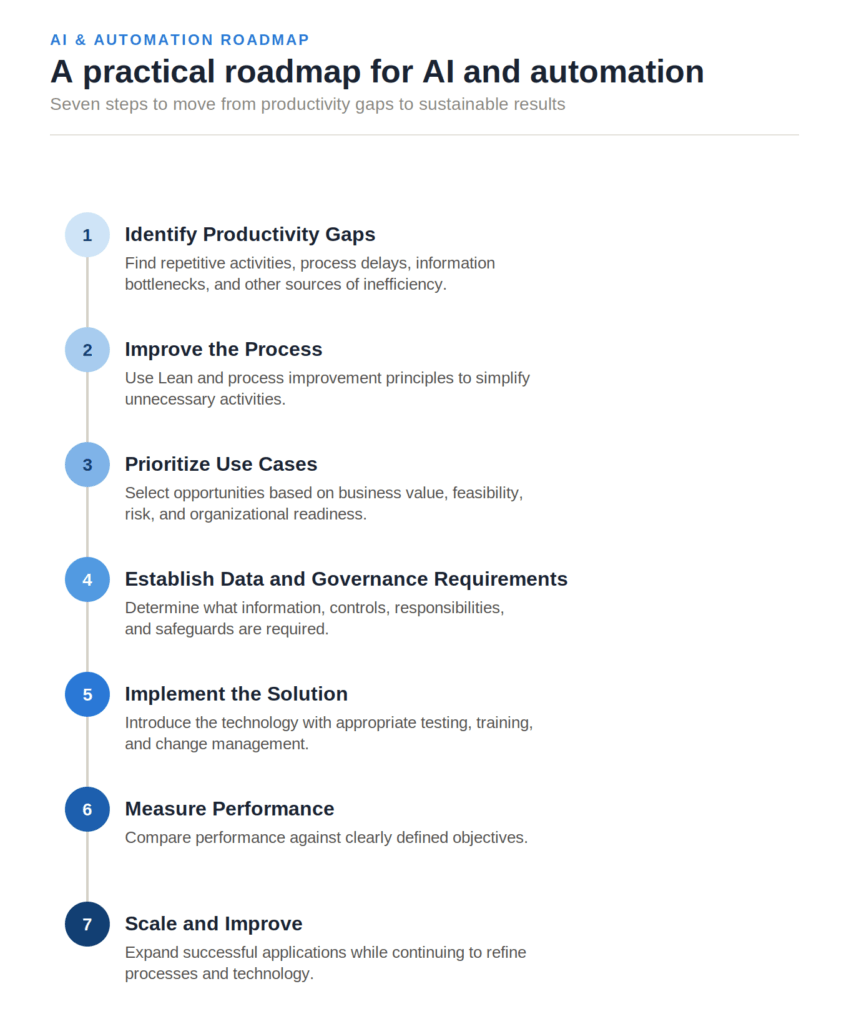
A Practical Roadmap for AI and Automation
Organizations can approach implementation through a structured sequence:
Step 1: Identify Productivity Gaps
Find repetitive activities, process delays, information bottlenecks, and other sources of inefficiency.
Step 2: Improve the Process
Use Lean and process improvement principles to simplify unnecessary activities.
Step 3: Prioritize Use Cases
Select opportunities based on business value, feasibility, risk, and organizational readiness.
Step 4: Establish Data and Governance Requirements
Determine what information, controls, responsibilities, and safeguards are required.
Step 5: Implement the Solution
Introduce the technology with appropriate testing, training, and change management.
Step 6: Measure Performance
Compare performance against clearly defined objectives.
Step 7: Scale and Improve
Expand successful applications while continuing to refine processes and technology.
Common Mistakes to Avoid
Automating Before Improving
Automation should not be used to preserve unnecessary process steps.
Choosing Technology Without a Business Objective
Technology adoption should be connected to a specific business requirement.
Ignoring Employees
Employees should be involved in identifying opportunities and adapting to changes in the way work is performed.
Underestimating Data Requirements
AI and automation initiatives can struggle when underlying data is incomplete, inconsistent, or poorly governed.
Measuring Technology Adoption Instead of Business Results
The number of automated processes or AI tools deployed does not necessarily indicate productivity improvement.
The more meaningful question is whether the organization has improved the outcome it originally wanted to improve.
Conclusion
Organizations seeking to improve efficiency and productivity with AI in Saudi Arabia should approach technology as an enabler of business improvement rather than an objective in itself.
Automation can reduce repetitive effort, improve workflow consistency, and strengthen information flow. AI can support analysis, knowledge retrieval, forecasting, and decision making when appropriate data and governance are available.
However, sustainable productivity improvement begins with understanding the process. By combining Lean thinking, business process optimization, continuous improvement, employee engagement, and appropriate technology, organizations can create a more effective approach to digital transformation.
The strongest technology strategy is therefore not the one that introduces the most automation or AI. It is the one that solves meaningful business problems, improves how work is performed, and creates measurable and sustainable value.
Frequently Asked Questions
How can AI improve efficiency and productivity in Saudi Arabia?
AI can support productivity by assisting with information retrieval, data analysis, forecasting, classification, and decision support. Its value depends on the quality of the data, the suitability of the use case, and appropriate human oversight.
How can automation improve productivity?
Automation can reduce repetitive manual activities, improve workflow consistency, accelerate information flow, and reduce unnecessary administrative effort when applied to suitable processes.
Should organizations improve processes before using AI?
Yes. Organizations should understand and simplify processes before automating them. This helps prevent inefficient workflows from simply being transferred into automated systems.
How does AI support digital transformation in Saudi Arabia?
AI can form part of a broader digital transformation strategy by supporting data analysis, information management, workflow improvement, forecasting, and decision support. It should be aligned with business objectives and appropriate governance.
How can organizations ensure AI delivers real productivity improvements?
Organizations should define measurable business objectives, select suitable use cases, ensure data quality, involve employees, establish governance, monitor results, and continuously improve the underlying processes.