Manufacturing organizations are under continued pressure to improve productivity, control costs, reduce waste, and respond to changing operational requirements. Achieving these goals requires more than adopting individual improvement tools or new technologies.
A stronger approach combines Lean manufacturing with Industry 4.0 capabilities.
Lean provides the principles and methods for identifying waste, improving flow, standardizing work, and solving operational problems. Industry 4.0 technologies can provide better data, process visibility, automation, and analytical capabilities.
Together, they empower organizations to scale their manufacturing consulting efforts in Saudi Arabia and achieve measurable improvements in operational performance.
Why Combine Lean and Industry 4.0?
Lean and Industry 4.0 address different parts of the improvement process.
Lean asks:
- Where is value being lost?
- What activities create waste?
- Why is the process not flowing effectively?
- What is causing the performance gap?
- How can the process be improved?
Industry 4.0 asks:
- What information can be captured automatically?
- How can operational conditions be monitored?
- How can data be analyzed more effectively?
- Where can automation reduce unnecessary effort?
- How can digital systems support better decisions?
The combination can be powerful because technology provides additional visibility while Lean provides the improvement structure.
The important principle is that technology should support operational improvement rather than replace it.
Starting With Lean Before Technology
A common mistake in digital transformation is starting with technology selection.
An organization may identify a new digital platform or automation opportunity before understanding whether the underlying process actually needs it.
Lean provides a different starting point.
The organization first examines the current process and identifies sources of waste.
These may include:
- Waiting
- Excess movement
- Defects
- Rework
- Excess inventory
- Unnecessary transportation
- Overprocessing
- Production interruptions
Once the problem is understood, the organization can determine whether technology can provide additional value.
This creates a more practical approach to Industry 4.0 adoption.
Using Digital Capabilities to Strengthen Lean
Industry 4.0 technologies can improve how Lean teams observe and analyze processes.
For example, automated data collection can provide more consistent information about production performance. Digital monitoring can help identify when process interruptions occur. Advanced analytics can reveal patterns that may not be obvious through manual observation. AI-supported analysis can help process large amounts of operational information.
These capabilities do not eliminate Lean problem-solving. They can make it more evidence-based.
Improving Production Visibility
Operational efficiency depends partly on knowing what is happening inside the process.
Traditional reporting may provide information only periodically.
Digital production monitoring can provide more frequent visibility into selected performance indicators. Teams may be able to monitor:
- Production progress
- Equipment status
- Downtime
- Cycle time
- Quality information
- Process interruptions
This can help teams identify deviations earlier.
However, visibility alone does not create improvement. The information must be connected to a structured response.
Using OEE to Identify Equipment Losses
Overall Equipment Effectiveness (OEE) can help organizations examine equipment performance through availability, performance, and quality. It can provide a useful starting point for identifying where equipment-related losses are occurring.
For example, an organization may discover that its primary loss is not major equipment failure but frequent minor interruptions. The improvement team can then investigate why these interruptions occur.
The objective is not simply to improve the OEE number. It is to understand the operational losses behind the number.
This makes OEE useful within a broader operational efficiency improvement system.
Improving Quality With Lean and Digital Tools
Quality problems can generate scrap, rework, additional inspection, and process delays.
Lean methods can help identify where defects are being created and investigate their causes.
Digital capabilities can strengthen this work by improving the availability and consistency of quality information.
For example, automated monitoring may help identify relationships between process conditions and quality outcomes.
The improvement team can then investigate the underlying cause.
This supports a shift from detecting defects toward preventing them.
Supporting Predictive Maintenance
Equipment reliability is closely connected to production performance. Unexpected equipment interruptions can affect throughput, process flow, workforce utilization, and delivery.
Data-driven maintenance can complement Lean and Total Productive Maintenance (TPM) approaches.
Organizations can analyze equipment information to identify recurring conditions associated with interruptions. This can help maintenance teams prioritize actions based on evidence.
The goal is not to replace maintenance expertise. It is to give maintenance and operations teams better information for decision-making.
Lean and Automation
Automation can improve consistency and reduce repetitive manual effort when applied appropriately.
But the decision to automate should follow process analysis. Before automation, organizations should consider:
- Is the process stable?
- Is the current method understood?
- What waste exists?
- What problem would automation solve?
- How will the improvement be measured?
If the process contains unnecessary steps, those steps should be reviewed before automation is introduced.
This prevents organizations from simply automating waste.
Supply Chain Optimization and Operational Efficiency
Operational efficiency does not stop at the production process. Material availability, replenishment, inventory, and internal logistics can all affect manufacturing performance.
Lean methods can help identify unnecessary inventory and movement. Digital systems can improve visibility into material requirements and operational status. Together, these approaches can support supply chain optimization.
The objective is to create reliable material flow while avoiding unnecessary inventory and handling.
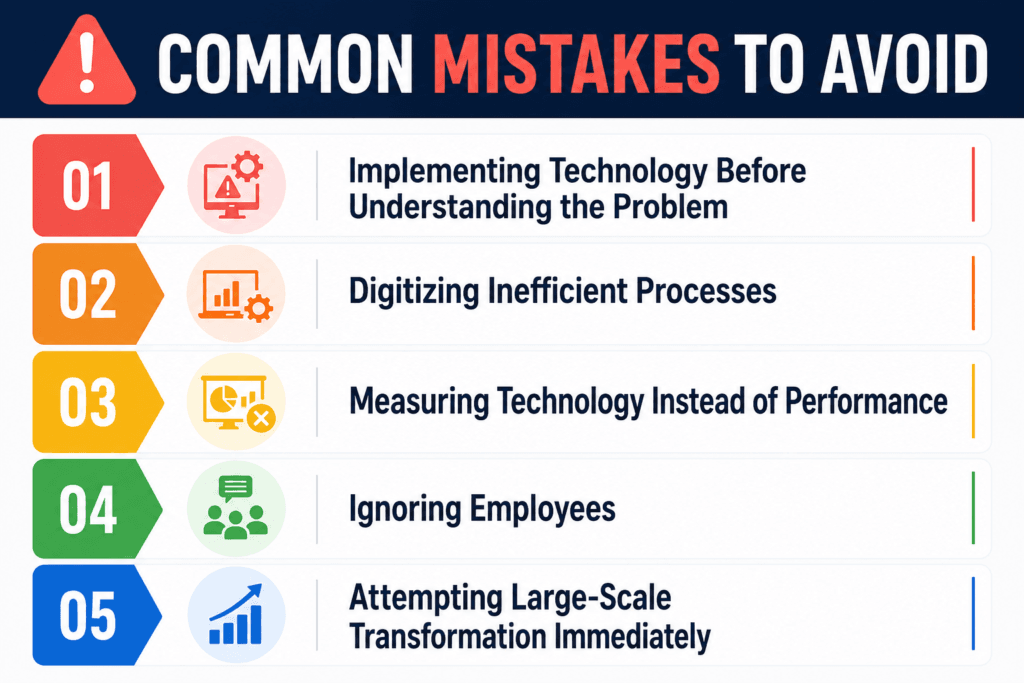
Common Mistakes to Avoid
Implementing Technology Before Understanding the Problem
Technology should be selected based on operational needs.
Digitizing Inefficient Processes
A poorly designed process may remain inefficient after digitization.
Measuring Technology Instead of Performance
The number of systems implemented is not an operational outcome.
The focus should remain on productivity, quality, efficiency, waste, and other relevant KPIs.
Ignoring Employees
Employees interact directly with processes and often understand recurring problems in considerable detail.
Their involvement is essential for sustainable change.
Attempting Large-Scale Transformation Immediately
A focused implementation can provide useful learning before broader deployment.
How Consulting Can Support the Transformation
Lean manufacturing consulting can benefit Saudi Arabia’s organizations by helping connect process improvement with technology adoption.
A structured consulting approach can involve:
- Current-state assessment
- Process mapping
- Waste identification
- Performance measurement
- Root cause analysis
- Improvement planning
- Technology opportunity assessment
- Implementation support
- Performance monitoring
The objective is to ensure that improvement initiatives remain connected to operational priorities.
Conclusion
Combining Lean and Industry 4.0 can provide a practical approach to improving manufacturing performance.
For organizations pursuing manufacturing consulting in Saudi Arabia, the key is to avoid treating Lean and technology as separate initiatives.
Ultimately, successful transformation is not about adopting the most technology. It is about creating better-performing processes and using technology where it genuinely helps sustain and extend those improvements.
Frequently Asked Questions
How can Lean and Industry 4.0 work together?
Lean can identify waste, process inefficiencies, and root causes, while Industry 4.0 technologies can improve data collection, monitoring, automation, and analysis. Together, they can support more informed and measurable process improvement.
Should companies implement Lean before Industry 4.0?
Not necessarily in every situation, but understanding and stabilizing the process before digitizing or automating it can reduce the risk of transferring existing inefficiencies into new systems.
How does Industry 4.0 improve operational efficiency?
Industry 4.0 can improve operational efficiency through better production visibility, automated data collection, advanced analytics, automation, equipment monitoring, and AI-supported decision-making.
How can OEE support operational improvement?
OEE can help organizations understand equipment-related losses through availability, performance, and quality. It becomes most useful when teams investigate the operational causes behind the measured losses.
What role can consulting firms play in Lean and Industry 4.0 transformation?
Consulting firms can help assess current processes, identify improvement opportunities, prioritize Lean initiatives, evaluate technology use cases, develop implementation roadmaps, and establish KPIs for measuring results.