
Manufacturing organizations operate within increasingly complex environments. Production performance depends on process stability, equipment reliability, workforce capability, material availability, quality, technology, and effective management systems.
When one part of this system underperforms, the impact can spread across the operation.
This makes the manufacturing challenges which Saudi Arabia’s organizations face more than isolated production problems. Improving performance often requires understanding how different operational factors interact.
This is where manufacturing consulting firms can provide value. A structured consulting approach can help organizations identify the root causes of inefficiency, prioritize improvement opportunities, and implement practical solutions that can be measured and sustained.
What Are the Main Manufacturing Challenges?
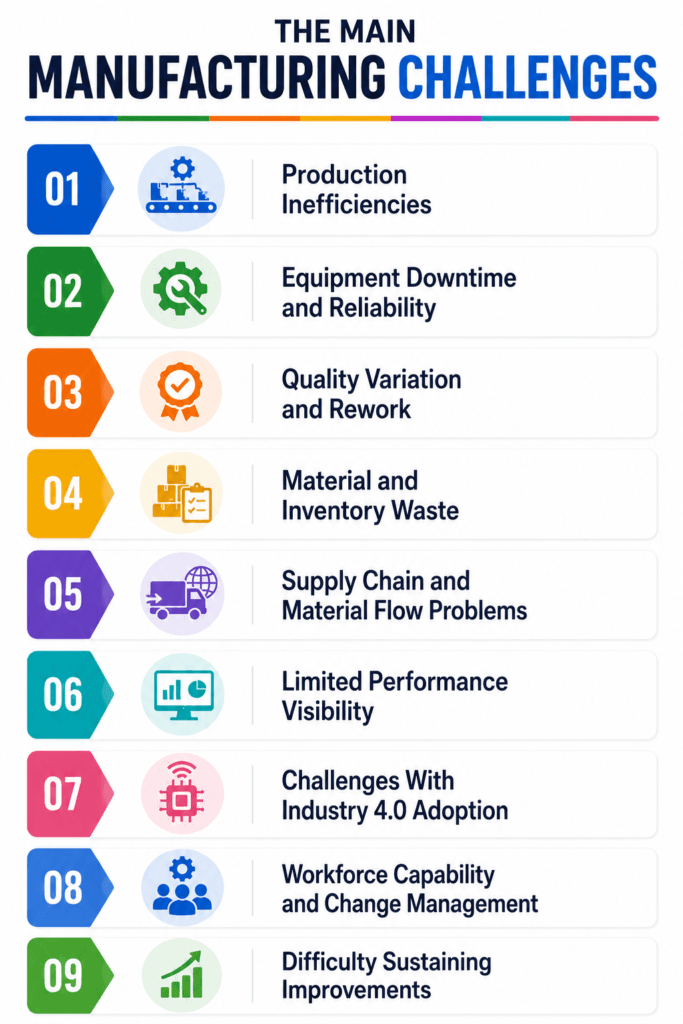
Manufacturing organizations can experience different challenges depending on their processes and operating models. However, several recurring areas deserve attention:
- Production inefficiencies
- Equipment downtime
- Quality variation
- Material and inventory waste
- Supply chain disruptions
- Limited performance visibility
- Digital transformation challenges
- Workforce capability gaps
- Difficulty sustaining improvements
These challenges are often connected.
For example, inconsistent processes can contribute to quality problems. Equipment interruptions can affect production schedules. Material availability issues can create waiting and excess inventory.
A successful improvement approach therefore needs to examine the complete operational system.
1. Production Inefficiencies
Production inefficiency can appear in many forms.
Work may spend excessive time waiting between process stages. Employees may perform unnecessary movements. Equipment may remain underutilized. Processes may involve repeated or unnecessary activities.
The first step is understanding where time and resources are being lost.
A manufacturing consultant can use process observation, Value Stream Mapping (VSM), performance analysis, and structured problem-solving to identify these losses.
The objective is not simply to make individual activities faster.
It is to improve the overall flow of work.
How Consultants Can Help
A practical approach can include:
- Mapping the current process
- Identifying major sources of waste
- Establishing performance baselines
- Investigating root causes
- Prioritizing improvement opportunities
- Testing process changes
- Measuring the results
This provides a structured approach to how manufacturing consultants fix production inefficiencies in KSA.
2. Equipment Downtime and Reliability
Equipment interruptions can affect production capacity, process flow, quality, and delivery performance.
However, simply increasing maintenance activity does not necessarily solve recurring reliability problems. Organizations need to understand why interruptions occur.
Performance information can be analyzed to identify recurring patterns.
Teams can examine:
- Frequency of interruptions
- Duration of downtime
- Recurring failure modes
- Minor stoppages
- Maintenance response
- Quality losses associated with equipment
Overall Equipment Effectiveness (OEE) can also provide a structured view of equipment performance through availability, performance, and quality.
The objective is to move from reactive problem-solving toward more systematic equipment improvement.
3. Quality Variation and Rework
Quality problems can create costs beyond the original defect. A defective output may require rework, additional inspection, material replacement, or process repetition.
Quality variation can also disrupt production flow.
Consultants can help organizations investigate where defects occur and determine whether the underlying causes are related to process conditions, standardized work, equipment performance, materials, or other factors.
Root cause analysis is particularly important.
Improving inspection alone may identify defects more quickly, but it does not necessarily prevent them.
The stronger objective is to improve the process so that defects become less likely to occur. It also highlights how the role of consulting services in Saudi Arabia’s industrial transformation extends to driving long-term stability.
4. Material and Inventory Waste
Inventory can protect operations from uncertainty, but excessive inventory can also tie up resources and create additional handling requirements.
High inventory levels may sometimes hide underlying problems in production or supply processes.
Consultants can help organizations examine:
- Material demand
- Replenishment processes
- Internal material movement
- Production lead times
- Inventory levels
- Material availability
- Process stability
The goal is not simply to reduce inventory. It is to create a more reliable material flow. This can support both waste reduction and operational efficiency.
5. Supply Chain and Material Flow Problems
Manufacturing performance depends partly on the reliability of material and information flows. A production process can be well designed but still perform poorly when required materials are unavailable at the right time.
Supply chain optimization can therefore become an important part of manufacturing improvement.
Consultants can examine the relationship between purchasing, inventory, replenishment, internal logistics, and production requirements.
This broader view can help identify problems that may otherwise be incorrectly attributed to production.
6. Limited Performance Visibility
Organizations cannot effectively improve what they cannot reliably measure.
Some manufacturers may have large amounts of operational data but limited visibility into which information actually matters.
A useful performance management system should help answer questions such as:
- Where is production capacity being lost?
- Which problems occur repeatedly?
- Where are quality losses concentrated?
- Which processes create excessive waiting?
- What actions are currently being taken?
- Are improvement initiatives producing measurable results?
Consulting can help organizations select relevant KPIs and connect them with specific operational objectives.
The goal should be useful information rather than excessive reporting.
7. Challenges With Industry 4.0 Adoption
Digital transformation creates significant opportunities, but adopting technology without a clear operational purpose can create complexity.
Organizations may consider automation, advanced analytics, digital production monitoring, AI-supported analysis, or other Industry 4.0 capabilities.
The important question is:
What operational problem will the technology solve?
A manufacturing consulting firm can help evaluate technology opportunities based on process requirements rather than technology trends.
A practical sequence is:
Identify the problem → understand the process → assess the data → identify the technology opportunity → implement → measure.
This approach can support more effective Industry 4.0 adoption.
8. Workforce Capability and Change Management
Manufacturing transformation depends on people.
New processes, technologies, performance systems, and improvement methods may require employees to develop new capabilities.
Resistance to change can also occur when employees do not understand why a change is being introduced or how it affects their responsibilities.
Consulting approaches should therefore consider both the technical and human aspects of transformation.
Employee involvement can support:
- Better problem identification
- Practical improvement ideas
- Stronger process adoption
- Better understanding of new systems
- More sustainable improvements
A process is only improved when people consistently work according to the new standard.
9. Difficulty Sustaining Improvements
One of the most common problems with improvement programs is that performance improves temporarily and then returns to previous levels.
This can happen when changes are not standardized or monitored.
Sustainable improvement requires:
- Standardized work
- Clear ownership
- Relevant KPIs
- Regular performance reviews
- Employee involvement
- Continued problem-solving
Consultants can help establish these mechanisms so that improvement becomes part of normal operations rather than a one-time project.
Choosing Manufacturing Consulting Services
Organizations evaluating manufacturing consulting services in Saudi Arabia should look beyond broad promises of transformation.
Several factors are particularly important.
Manufacturing Expertise
Consultants should understand manufacturing processes, operational performance, and the relationship between different sources of loss.
Evidence-Based Diagnosis
Recommendations should be based on process observation, data, and structured analysis.
Practical Implementation
The proposed solution should be realistic within the organization’s operational environment.
Measurable Results
Improvement initiatives should have appropriate KPIs and clear baselines.
Sustainability
Successful improvements should be capable of being maintained after implementation.
These considerations can help organizations identify a manufacturing consultant for KSA capable of supporting practical operational improvement.
Conclusion
The manufacturing challenges which Saudi Arabia organizations face can range from production inefficiencies and equipment downtime to quality variation, material flow problems, digital transformation, and workforce capability.
These challenges are rarely solved effectively through isolated interventions.
Manufacturing consulting firms can provide a structured approach by assessing the current state, identifying root causes, prioritizing opportunities, developing practical solutions, and measuring results.
Frequently Asked Questions
What are the biggest manufacturing challenges in Saudi Arabia?
Common challenges can include production inefficiencies, equipment downtime, quality variation, material flow problems, excess inventory, limited performance visibility, Industry 4.0 adoption, workforce capability, and sustaining improvement initiatives.
How can manufacturing consultants improve production efficiency?
Manufacturing consultants can analyze current processes, identify waste and bottlenecks, investigate root causes, develop improvement plans, support implementation, and establish KPIs to measure and sustain performance improvements.
How can consultants support Industry 4.0 adoption?
Consultants can help organizations identify appropriate digital use cases, assess process and data readiness, prioritize technology investments, develop implementation roadmaps, and connect technology adoption with measurable operational objectives.
How can manufacturers overcome operational challenges?
Manufacturers can begin by understanding the current state, identifying performance gaps, investigating root causes, prioritizing high-impact problems, implementing targeted improvements, and measuring results against a clear baseline.
What should companies consider when selecting manufacturing consulting services?
Companies should evaluate manufacturing expertise, problem-solving methodology, implementation capability, measurable improvement practices, and the consultant’s ability to develop solutions that can be sustained within normal operations.